Stop Restaurant Profit Leaks: Food Cost, Labor & Menu Pricing
Your restaurant can be filling seats while profit slips out through inconsistent portions, untracked inventory, inefficient scheduling, and menu items that contribute less than you think.
In Episode 508 of the Restaurant Rockstars Podcast, Roger breaks down the standard operating procedures that help restaurant owners understand their costs, strengthen daily operations, and keep more of what they earn.
Drawing on 23 years of restaurant ownership, Roger shares practical examples of the systems he used to track inventory, monitor labor, improve menu profitability, and train a team to sell with confidence.
What you’ll learn
How to organize restaurant inventory counts: Arrange your count sheets by storage location and count consistently before new deliveries arrive.
How to calculate food and beverage usage: Understand beginning inventory, purchases, and ending inventory, while keeping food and beverage calculations separate.
Why labor needs more than a payroll total: Track total labor and kitchen labor to understand how scheduling affects your results.
Why every menu item needs a cost sheet: Compare ingredient costs, selling prices, and contribution dollars to identify opportunities.
How portion standards protect margins: Use written specifications, plate photographs, and regular coaching to build consistency.
How to approach slower nights: Evaluate promotions, sales patterns, and operating costs before deciding what to change.
Where additional revenue can come from: Explore merchandise, catering, private parties, and membership programs.
How to develop Sales Stars: Give your team the menu knowledge and confidence to make recommendations guests appreciate.
Where should restaurant owners start?
Start with reliable inventory counts and accurate menu costs. These give you a clearer picture of what your restaurant uses, what each dish costs to produce, and where to investigate waste or inconsistent execution.
Then build a regular management routine around labor, purchasing, portion standards, and staff training. A spreadsheet only becomes useful when your team acts on what it reveals.
Restaurant resources
The Profitable Restaurant Operator Academy
Explore training, templates, and operating tools for restaurant owners and managers:
https://www.restaurantrockstars.com/joinacademy
Free Prime Cost Score Card and more restaurant resources
https://www.restaurantrockstars.com
The takeaway: Run a business and build a brand. Give your team clear standards, know your numbers, and make profitability part of the daily routine.
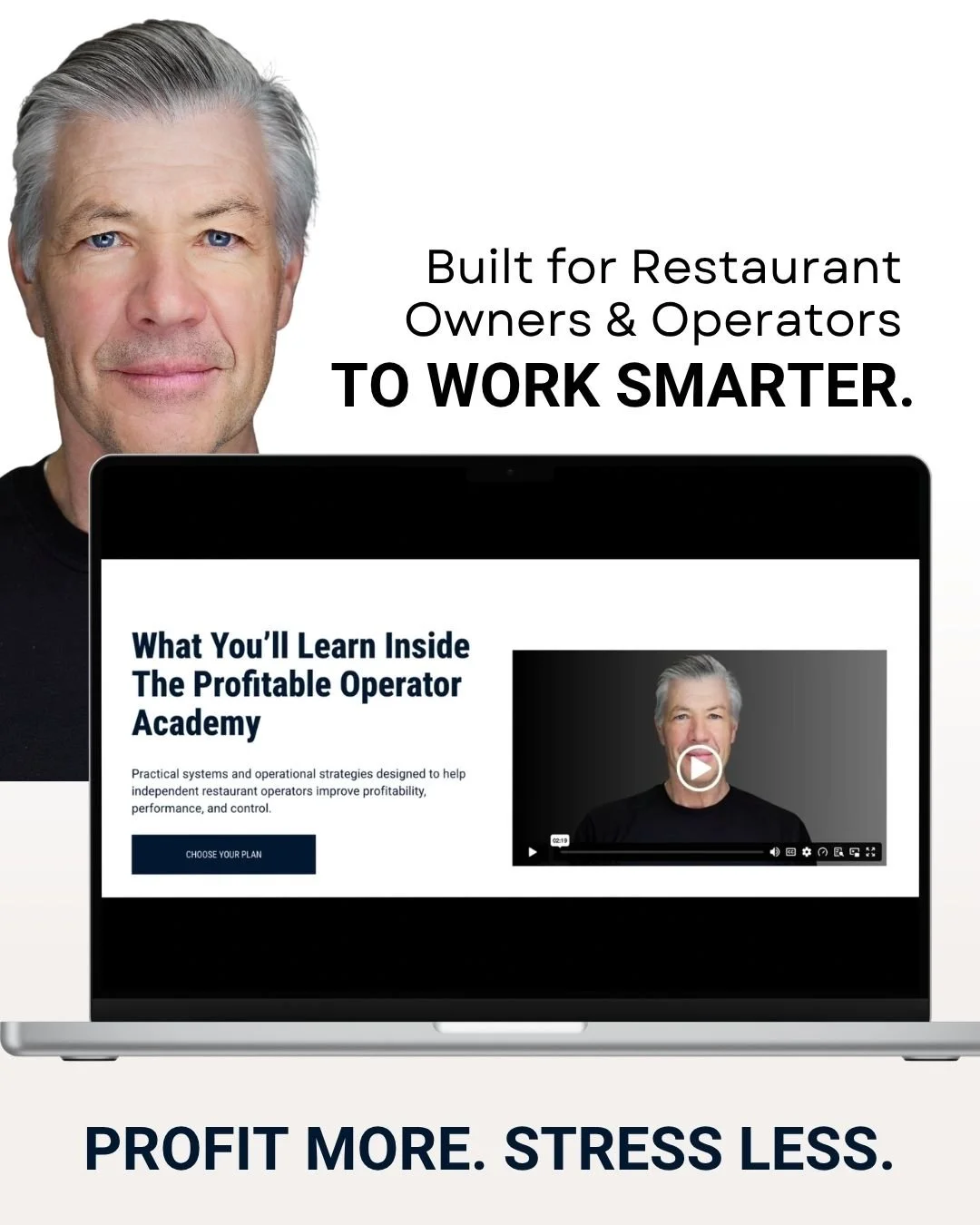
Run a Smarter, More Profitable Restaurant.
Discover the proven systems & solutions that drive sales, train staff, and maximize your margins.
Explore The Restaurant Academy now: https://restaurantrockstars.com/joinacademy
Smithfield Culinary serves up perfect proteins for every dish, every daypart like Smithfield’s new ready to eat select bacon, new ground chorizo or the broadest portfolio of pork. When you partner with Smithfield, you serve what you love and your guests will love what you serve.

In a busy restaurant missed calls mean missed sales opportunities. Yelp Host is an AI phone answering service that handles reservations, waitlists, and takeout orders 24/7. Yelp Host Speaks 17 languages, handles multiple simultaneous calls, answers questions, books tables and sends everything right to your kitchen.
Restaurants always need Capital when THEY need it! Problem is you don’t have time to wait, you need the cash now! Forward Financing has funded more than $5.4 billion to over 100,000 small businesses, and 10,000 restaurants just like yours. Forward funds anywhere from $5,000 to $500,000, often with same-day FUNDING.
Connect with Restaurant Rockstars:
LinkedIn Restaurant Rockstars: https://www.linkedin.com/company/restaurant-rockstars
LinkedIn Roger Beaudoin: https://www.linkedin.com/in/roger-beaudoin/
Facebook: https://www.facebook.com/restaurantrockstars/
Instagram: https://www.instagram.com/restaurantrockstars
X: https://x.com/RestaurantRock1
Listen to the Restaurant Rockstars Podcast on Your Favorite Podcast Player:
iTunes - https://apple.co/2WaKyqV
Spotify - https://spoti.fi/3xGuOd0
Stitcher - https://bit.ly/3iFGAAb
Soundcloud - https://bit.ly/3lYBhho
-
Hey there. Welcome back to the podcast. I've got to ask you the question, is your restaurant busy but you're not making any money? I was absolutely shocked to hear a recent National Restaurant Association report that shows that about 35% of restaurants lost money in the first half of 2026. That is shocking Don't let this be you.
So today's episode is all about SOPs, or standing operator procedures, standard operating procedures that'll help you maximize your profit and make more money in your restaurant, okay? Let's start by talking about inventory. I travel the country often. I speak to lots of restaurant owners just like you, and I ask them lots of questions.
And one of the first is always, "Are you taking regular inventory?" And I'm also shocked to hear that so many operators think that that means placing next week's order. No, it doesn't. It means calculating the true value of your goods in hand at any given time. And when I s- talk about goods, I'm talking about your food inventory and your beverage inventory.
Now, there's a process, but it's the exact same for both. But you have to track that because it is one of your biggest expenses in the restaurant. We're gonna go over this. We're gonna talk about prime cost because that is such an important SOP also to calculate. But let's get back to inventory. Okay, I think it's vitally important that you take inventory four weeks in a row.
You need a simple system, okay? And you need to find the value of your goods on hand at any given time, your food goods and your beverage goods. Now, I used to say that not taking inventory is like leaving hundred dollar bills all over your restaurant for anyone to just pick up and walk away with, because think about it, you could have thousands of dollars of value in all of your storage areas, and anybody can just take this.
Now, take it from me. I owned restaurants for 23 years. And yes, there were times I had people take things from me. A long time ago, I had a chef that literally had a habit, a bad habit, I won't talk about what that is, but literally cases of steaks disappeared out the back door until we found and put a stop to it.
So know that this happens, and that there are seemingly instances where your team, they need things. They live in their own apartments or houses or whatever, and they need condiments, and they need toilet paper, and they need silverware, and this stuff just disappears unless you've got a system to stop it.
And you have to be a great employer. You have to build a team with team spirit and mutual respect. But let's get back to inventory. It's vitally important to track your inventory every single week for four weeks in a row. Why? Well, let's just say that your pr- target, your sweet spot I call it, food cost might be 32%.
So you calculate this, and we'll go through the process, but let's just say you calculate it the first week and you get a 32%. You're happy with that. You do it one week later- And now it's a 33. Hmm, what happened? And then you do it another week, and now it's a 29 and a half. And then the last week it's a 36.
You don't know what your food cost is because it's all over the place. There's no consistency. But if you hit a 32, a 32, a 32 and a half, okay, a 32 four weeks in a row, then and only then you can go to a 30-day inventory. You got this. Okay? It's a simple process, but it requires a formula, a couple of formulas, and it requires a system.
Okay, so the first thing you need to do is arrange all of your goods in the way it's most efficient to count. So you have storage areas across your restaurant. Most restaurants have walk-in coolers. They have freezers. They have coolers on the floor and sandwich fridges and dry storage areas as well. All these are storage areas.
So imagine you have a template that lists all of these different storage areas in the way you would most efficiently count it. Now, most people would start with their walk-in and then go to their freezers and then their other coolers, and then finally dry goods. So use your order guides or your invoices because on the template First of all, the template is available.
If you don't already have one, we have a template in the Profitable Restaurant Operator Academy at restaurantrockstars.com and an easy explainer video that walks you through this process. But let's get to it. Imagine you use your invoices and your order guides, and all your products are listed in the area they're stored, your walk-in, your freezers, you get the idea.
It also lists how those products come in, in what quantities. Is it by the full case? Is it by the single can? Is it by the pound? Is it a block of cheese? You get the idea. It all has to be calculated for most accuracy, but that's how you list things. Now then, once you've got all this set up, you usually have two people that go through methodically, and it's really great if you're the owner or the general manager that you have this process and that you do it a couple of times with someone you can trust.
Now, one person is gonna have the template, and the other person's gonna actually do the physical counts and call out to the other person what the quantity is, and you write that down. Now, the template that I'm talking about from the academy lives on your computer, and then once you take the, the actual counts, all you have to do is transfer that to the template on the computer, and then it's gonna automatically calculate the value, the dollar value of every single item, and then total it at the bottom of the template, and then it's gonna give you a value.
It might be five thousand dollars. It might be ten thousand dollars. It depends on the size of your restaurant. But also, here's another important point. When do you calculate? When do you do these physical counts? The best time is at the end of a busy weekend. Why? Because most of our restaurants are busy Friday, Saturday, and Sunday, and you wanna count this when your inventory levels are at the absolute lowest, and that's usually Sunday night at the close of business.
Now, you might be burned out and tired, and you don't wanna count the goods at the end of Sunday. So make sure you do it first thing Monday morning. I don't care if you do it Sunday night or Monday morning, but the important thing is make sure you do it early enough before the delivery trucks start coming in on Monday because the last thing you wanna do is be counting goods while the delivery driver's wheeling more goods in and putting them on the shelves and putting it on the floor, and then you can see where I'm going with this.
So four weeks in a row, count your goods. If you hit your sweet spot four weeks in a row, then you can go to a 30-day inventory. Okay? That's what makes that easy. Okay, next Four weeks in a row. Wow. It sounds intimidating at first, but don't worry. Once this becomes routine, it's easy. It shouldn't take too much time if you count it at the end of a busy weekend.
All right. Now let's just go back to the weeks. The very first week that you count your inventory, the very first day that you do it, that number becomes your beginning inventory. Then one week goes by and a certain number of things happen. During the week, I just mentioned delivery trucks come in. You might get deliveries twice a week, three times a week.
Those are your purchases. Then you're gonna count it again at the end of that week, again, on a Sunday night or Monday morning, and that becomes your ending inventory. Because there's another formula. Once you do these counts, there's another s- template that I have in the academy, but it is now the calculator formula for your cost of goods food or your cost of goods beverages.
Okay? So here's the formula Beginning inventory, your first count week one, plus your purchases on all the different days that, you know, new supplies came in the door from all your different suppliers, minus ending inventory, the second week you counted, equals what we call usage. Now, stay with me here because it's not complicated, and again, all this is in the video explainers if you choose to go to the academy.
But anyway, beginning inventory plus purchases minus ending inventory equals usage. So what's usage? Usage is everything that you sold to a customer for full price. Anything that you discounted to a team member, maybe it's 50% off. Anything that got wasted or thrown in the trash or stolen out the back door or comped and voided off checks, that is usage.
Now, the template automatically calculates that. You don't need to worry about it. The only other number you need to enter is your weekly sales. Now, don't make the mistake of including... I've seen lots of restaurants include mop heads and plastic wrap and rubber gloves and dishwasher soap. No. If it doesn't go on the plate and if you don't serve it to a guest, it's not food cost.
Okay? So make sure that you separate all this off of your invoices when you're p- filling in your totals. All right? That's a, a word to the wise. That's a mistake I've seen happen over and over again. Okay, so then you plug in your weekly food sales only or beverage sales only, and don't combine the two.
This is a process that you first do for food, and secondly, you do it for beverages. But don't combine the two. Do them separately. And then that formula is automatically gonna calculate your food cost percentage, your 32 if that's your sweet spot, and your beverage cost percentage. Okay, excellent. Here we go.
Running a restaurant means making big decisions when you see an opportunity. Maybe it's time to upgrade the kitchen, cover payroll, add more space, or replace a piece of equipment. You can't wait weeks for a traditional bank decision. You need the cash when your business needs it. So a big thank you to our new sponsor, Forward Financing.
Since 2012, Forward Financing has funded more than $5.4 billion to over 100,000 small businesses and 10,000 restaurants just like yours. With a 4.6-star rating on Trustpilot, you can be confident making your next move. Forward Financing offers $5,000 to $500,000, often with same-day funding, so you can keep your restaurant moving forward.
Ready to see what you may qualify for? Visit go.forwardfinancing.com/restaurants
Smithfield knows that to meat lovers, a great serving of their favorite cut is so much more than just food. It's an experience. That's why Smithfield is committed to offering you the perfect protein for every dish and every daypart. Like their new ready-to-eat Smithfield select bacon, where chefs won't leave a mess and patrons won't leave a trace.
Or new ground chorizo, letting you serve up tasty, smoky heat. And turn to Smithfield for the most comprehensive portfolio of pork products such as bacon, ham, sausage, and more. When you partner with Smithfield, you'll serve what you love, and your hungry, carnivorous patrons will love what you serve. For more information or to order products, visit smithfieldculinary.com/smithfield.
Next on the list, labor cost. Oh my gosh, labor, labor, labor, labor. Everybody complains about labor. One, I know there's a labor shortage, but two, the cost of labor is so much more than when I was in this business. I had this amazing grill guy, you know, and he could cook 30 steaks on the grill at once, and everything was perfect and nothing ever came back, and he was just a rockstar.
I would now have to pay him, like what I paid him back in 2014 when I sold this restaurant, I would now have to pay him an extra 10 or $12 an hour above what I paid him then, and that's just the cost of labor. I don't need to tell you this. So you need to calculate your labor cost. Now, I used to do this two ways, and I recommend you do it both ways.
Again, it's a simple process, and again, there's a template for this at restaurantrockstars.com, but here's, here's the way it works. You must calculate your total payroll divided by sales every single week. And when I say total payroll, it's what you pay yourself, what you pay your managers, your hourly employees, all the taxes, you know, the Social Security and the state taxes and this, that, and the next thing, and the amount you pay your payroll processor.
All of that comes in an envelope or it comes in, you know, via email or whatever, and there's one total that includes all those things. That's your total labor cost for the week, or biweekly if you pay every two weeks. But most restaurants pay weekly. You divide that number by your sales that week, and that gives you your total labor cost percentage.
Now, the second way I used to calculate it was doing kitchen-only labor, okay? Because again, kitchen payroll is your most expensive part of the payroll, and I'd calculate that the same way. The only difference is you remove anyone that's not related to the kitchen, and then you divide by food sales only, okay?
Not beverage sales, just food sales. And that gives you your kitchen labor. Now My template literally lists week by week by week those two different calculations, the total labor cost and the kitchen labor only. Now imagine you have an optimum week where you have a certain amount of business that's fairly steady from week to week, and you hit this magic number, this sweet spot that you're totally stoked with.
Maybe it's a 28% labor cost, and you know that you had optimum scheduling and that you cut people and you didn't need them, and you did such a great job that that was super efficient and you made a lot of money on those sales versus the labor it took to produce those sales. Well, if you can do it once, you should be able to do it again.
And any leader that's in charge of scheduling or in charge of payroll should monitor what your labor cost every single week to really give it all they've got to stay in that sweet spot. Now, I used to incentivize my leaders that were in charge of scheduling. If they hit that sweet spot every single week, they got an incentive, a little extra bonus, and they were incentivized to do so.
And I'll tell you, they were hypervigilant about cutting people that weren't needed, about staggering shifts when people were brought in. You know, they didn't need three hosts on a certain night at 5 o'clock when we didn't get busy till 6 o'clock. You get the idea. So you stagger people. You bring in one person, then you bring in another when it gets a little busier.
You know what I'm saying. And then you're absolutely rock certain to let people go when you know that the business is gonna drop off, and you rotate it and you make it fair. Okay, so that's really, really important. But again, track it both ways, total labor and kitchen labor. Now, once you have accurate percentages for your food, beverage, and labor cost, now we're gonna talk about prime cost.
It is an industry benchmark. It's absolutely critical that you calculate this all the time. Okay? Now I have a prime cost calculator. It's absolutely free. And again, it's at restaurantrockstars.com, so check that out. All you need to know is your numbers. You plug your numbers into this, um, prime cost calculator, and it's gonna tell you if you're in that sweet spot.
So what's the sweet spot? First of all, the prime cost formula is this. It's food cost percentage plus beverage cost percentage divided by two because you average your food and beverage cost to get one average number, and then you add labor cost percentage. You add those three things together, F and B cost percentage divide by two plus labor cost percentage gives you your prime cost.
Now, the industry standard is this. They say that to make any money in this business, your prime cost percentage should not exceed 55%. of sales. Now, what does that mean? That means for every one dollar of sales, that no more than fifty-five cents goes to food, beverage, and labor, which leaves only forty-five cents left over from every dollar of sales to pay every other expense.
And you know what those are. Obviously, your rent, your utilities, the dumpster in the parking lot, the linen, the landscaping, the maintenance, the snow plowing, if you've got it in a cold climate like mine, all of these other expenses, and the list goes on and on and on. So the sweet spot here is fifty-five percent of sales, and if it gets higher, obviously you've got less money to pay all those other expenses.
So it behooves you and your leadership team to stay in that sweet spot. Okay. Free Prime Cost Calculator makes it easy. Don't forget about that It's at restaurantrockstars.com. Okay. Now I absolutely have to talk about the biggest needle mover of all, the biggest needle mover. You absolutely must, must, must cost out every single item on your menu in every single category.
And when I say that, every single menu item has an ingredient cost total, and you get this information obviously from your order guides, your invoices again. But a cost sheet for any given item should include several things. One, the total plate cost. That's a list of all the ingredients by their cost.
Okay, and again, I have a template for all these things, everything I'm talking about. Okay. Then it also calculates, um, your food cost percentage and your profit because if you put your menu price on the cost sheet, it's simple math to determine the food cost percentage and the profit. Okay? Once you have all that information, we look at each one in each category, and we compare the profit that it contributes, and you might be surprised that there's a huge dollar difference between items in different categories.
I see this all the time when I work with restaurants. In the appetizer category, they might have five or 10 appetizers, and this appetizer might contribute a $3 profit, and this appetizer might be a $4 profit, and the next one's $4.50, and another one might be $5. On the entree side, it's even scarier. I see restaurants have a difference of $8, $10, $12 difference in profit on entrees.
It's crazy. So the whole point is re-engineering your menu so that every item in each category contributes a very similar profit. Now, that takes some adjustment, and that takes working with your kitchen manager that really knows the ingredients you're buying. Or if you work with a large food service supplier, one of the broadliners, if you do a lot of business with them, they will cost out your menu for you.
And once this information hits you like a ton of bricks, oh my gosh, it's like my lower cost items are stealing sales from my higher profit items, right? My... I'm sorry, my low profit items are taking sales from the highest profit items, what I wanna sell and what I could be selling. I need to do something about this.
Now, portion controls are very, very important also. So these broadline suppliers have executive chefs in just about every area in the country, and if you, again, if you're a very steady longterm customer and you do good business with them, you don't ask, you don't get. Ask them to cost out your menu for you.
And then once all this information is there, they will work with you to tighten up that menu, re-engineer it, if you will, all right, and make sure that the dollar spread difference in each category is much, much closer. Now, I have a benchmark for this. On the more expensive items on your menu, like entrees- My benchmark was always within $1 of each other, not $8, $9, $10 or more.
Same with appetizers, $1 Lower, lower, lower, lower cost items on your menu, such as desserts or soups and salads. My benchmark there is 50 cents. It is very possible to tighten that menu so that you're not losing many, many dollars because lower profit items are stealing sales. That is the biggest needle mover.
Now let's go back to portion controls.
In a busy restaurant, missed calls mean missed sales opportunities. Yelp Host is an AI phone answering service that handles reservations, wait lists, and takeout orders twenty four seven. It can answer your restaurant's phone, take your takeout order using AI, and send orders straight to your restaurant's POS, all with no commission fees.
Yelp Host speaks seventeen languages, handles multiple simultaneous calls, answers questions, books tables, and sends everything right to your kitchen. Yelp Host helps staff focus on your guests and delivering true hospitality. Yelp Host integrates with OpenTable, Yelp Guest Manager, and major POS systems.
Want real results? Buttermilk Ranch saved eighty hours of labor per week. The Metropolitan booked five hundred plus tables in three months. Go to business.yelp.com/rockstars
I mentioned that a moment ago. Long time ago, you might have heard this story. My very first restaurant, Wood-Fired Pizzeria, I had multiple pizza makers making the same pizzas over and over again. We had one size pizza only because that's the way they do it in Italy, and I wanted to be authentic.
And I saw different pizza makers putting different quantities of toppings on the very same pizza they were making. And I went to my kitchen manager and I said, "What's the spec call for on a pepperoni pizza perhaps?" We've been open three weeks. We're selling hundreds of pizzas a day. I mean, it was a really busy place.
And all of a sudden she's like, "Well, the spec calls for 10." And I'm like, "Well, I just watched two other pizza makers put 12 or 13 slices of pepperoni on that pizza. Times how many hundreds of pizzas have we sold in the last couple of weeks? What is that doing to our profit? What is that doing to our food cost?"
Portion control standards are so important, okay? That's the key to profitability also. Ensure these standards. Have a photograph of what the plate presentation should look like. Have a list of how many, how much, you know, quantity goes on any given dish, and make sure that you have checks and balances and that you have somebody watching.
I used to watch all the time until people knew, "Hey, Roger's watching. We gotta make sure that we stick to the standard." And then we had our leaders doing the same thing, and then pretty soon our portion controls were rock solid. And that's a way to lower your food costs and increase your profit. So don't be surprised if your menu is losing you money every single day.
Wanna find out? I have a tool called the Menu Profit Accelerator, and it's a total video tutorial. We tell you how to do it and all the instructions and everything to do, and you can follow this very same formula. The template is there. As long as you cost out your menu and you plug in all the information, and then you go to your point of sale and you plug in volume of sales over a long period of time to give you that as most accurate information.
If you change your menu once a year, you got a year's worth of data. You change your menu twice a year, you got at least six months of data. You plug all this information into the template, you press the go button, and it automatically shows you where you're losing money every single day and what to do about it.
We've got a whole series of tips on how to tighten that menu and how to stop the bleeding. And the very first one is training your team on which items are the most profitable so that they can make those recommendations every shift, every day at the tables. So that's kind of huge. So this is the main reason why restaurants might be busy and filling their seats, but they're wondering, "Why is my bank account not growing?
Why am I not making enough money?" Okay, in my consulting practice, and I'll do this for you also, I coach and consult restaurants on menu profitability. And literally in the last couple of years with multiple restaurants, I have found anywhere between $125,000 to $360,000 per restaurant location in lost potential profit against their total annual sales.
What an eye-opener. OMG, right? It hits the owner and the GM like a ton of bricks, but we immediately stop the bleeding and we fix it, and you can do it too, or I'll help you do it. All right. Do you have a slow night or two? Not every restaurant is busy seven days a week, right? Usually it's a Monday.
Sometimes it's a Tuesday. I had this problem. My busy wood-fired pizzeria I told you about, my slowest night was Tuesday, and like, we gotta do something about this. So we came up with something called $5 Pizza Night, and we offered literally back then, and yes, it was many years ago, but a $5 two-topping, single size 12-inch pizza for five bucks.
And we drew a crowd, and we knew that we might break even or make a little bit of money on the pizza, but what we really were doing was we had a full bar and 18 taps and draft beer, and we brought in a live acoustic musician, and we sold a lot of alcohol, beer, wine, beverages, in addition to the pizza. And then we had a whole retail merchandise program, and people started buying the T-shirts, and suddenly Tuesday became one of our biggest nights.
So if you have a slow night, my first recommendation would be, of course, come up with a special promotion. Maybe it's a wine tasting if you've got a nice place. Maybe it's karaoke night if you're a family casual place. You get the idea. Try something. Experiment. Drive business on your slow nights. Okay? To know what your daily break even is, is the next big needle mover.
Because on a slow night, you need to know how much you have to sell in order to not lose any money, but not make any money. That's your break even point, daily break even. So that's a formula also. So imagine there are two types of costs. You've got fixed costs and you've got variable costs. Now, everyone has records somewhere.
Maybe it's on your computer, maybe it's in the cloud. I've said this before, maybe you're old school and you have old, you know, filing cabinets like I had 14 years ago when I owned restaurants. Irregardless, maybe you have an office manager that tracks all this stuff. But you get invoices and bills for s- for every single expense in your restaurant, don't you?
So you need to put a list together, okay? You need to pull out every single invoice wherever you store them, and whether that invoice comes in on a monthly basis or on a weekly basis Okay, it's all part of the formula. But let's start with fixed costs. What's a fixed cost? A fixed cost is something that doesn't vary depending on the hours or the days you're open during the week.
It doesn't matter, okay? You've got to pay your rent whether you're open seven days a week or you're open three days a week, okay? Your rent doesn't care. Your landlord wants, wants their money, right? Same with the dumpster in the parking lot. You know, you could be open seven days a week or three, doesn't matter, you got to pay those fixed expenses.
They don't vary based on the hours you're open. Now, the variable costs, there's a lot more of those. That's your payroll. That's your cost of goods. That's your utilities. That's your repairs and maintenance. All those things go up or down based on hours open, don't they? So separate those two, but make a list of all of your fixed expenses.
Now, you want to do this on a monthly basis, okay? Because ultimately, when you add all these things up, and there's a template I have for that as well, when you add them all up, you divide by 30, and that gives you your break-even number on a daily basis. Now, that's how much money it costs you to open the doors and hope for the best.
You know, you put the key in your lock, you open it, and you walk in, you turn your lights on, you got staff on the floor, in the kitchen, ready to serve the guests, make the food. You know, you got food in the walk-ins, the, you know, the utilities are going, the TV sets, all that kind of stuff. What does it cost you?
It might be $900 a day. It might be $2,000 a day or even more, depending on the size of, of your place and your expenses. But the point I'm making here is on your slow night, if you're not consistently hitting at least that daily break-even number, whether it's $1,000 or $5,000, then you need a special promotion to drive business on that night.
And hopefully, you're tracking your sales on a weekly basis. I did that as well. And again, it was all part of that labor, template I told you about, where we tracked our optimum labor with our optimum sales every single week. Okay, so you know on a daily basis what your sales should be if you've got consistent business.
And if you're not at least hitting that daily break-even, if you can't come up with a special promotion to drive business on that night, then it makes more sense to close and give your staff a day off because you're going to lose less money by closing the place than actually staying open. It's been proven, okay?
Consistently hit the daily break-even. That's your goal. That's what you need to do. All right. Next, don't just sell food and drink, okay? A lot of, a lot of people think that a restaurant is just selling food and beverage. No, there are lots of additional profit centers that you can have in your restaurant that are gonna drive more business and make it more of a draw for your guests.
What are some of these things? Well, what if you build a profitable brand? What if you build a recognizable brand so people recognize your logo, and you've got regulars that like your place, and they love the vibe of your place? They can be walking ambassadors for your place. They'll pay money to advertise your business if you start a retail merchandise program.
Think about putting your logo on T-shirts and on trucker hats and on hoodie sweatshirts and on flasks and on all sorts of stuff, stickers. You can sell all this, and it's like you merchandise this. You hang it up. You make it so visible that it's impulse purchases because impulse purchases happen in your restaurant all the time.
Maybe someone has a gift item they need to buy for a special person. Maybe they're on vacation, and they want to bring something back as a reminder of a great time they had at your place. Retail is very, very powerful. Now, you start out small, okay? You start with a T-shirt with one logo and hang them up.
You might even have your team wear them as uniforms. I did that in several of my restaurants, and it sells itself, and impulse purchases happen. When you've proven a certain number of sales per day and the sizes, you know, you don't go super, super deep. You test it out. You bring in a case, and you mix it up between small, medium, and large T-shirts, and you see what the big m- m- needle movers are there, and then that's how you place your orders for the future.
When your T-shirts prove really successful, then expand the line. If you've ever been to a theme park, you know that you can't walk in and out of that place without walking through five or 10 different retail outlets selling this stuff that catch your attention. Take a cue from them. Merchandising is the key, so that's a big deal.
Besides that, there's also catering. There's private parties. Mug clubs, don't get me started about the mug club. Imagine if you sell draft beer or you even have a coffee shop. You can create this loyalty membership club that is super profitable, and it can be a total cash generator, cash flow generator, if you bring in these specialty mugs.
Now, some people think that that's a cost, but it can be an investment, an investment in your time and your creativity because we got sponsors that put their logo on the mugs, and they bought the mugs, and they bought the custom mug club T-shirts that we passed out to everyone for free just for joining the club.
That was value added, and you can charge anywhere from $50 to $100 and even more for membership for the club that renews every single year automatically. You've got their credit card on file. It'll automatically charge their credit card. If you've got it set up through your website, you can renew online.
It's a really, really powerful thing. Now, you might think that bringing in all this membership money is great and, well, here's an example. When I sold my place, my, my flagship restaurant, we had over 1,000 mugs that we had sold every year, and we charged $60 a mug. And now they've raised the price, but back then we brought in at least, I don't know, $70,000 came in the door every single year just from mug memberships.
Now, I'm not suggesting you can build a club to that size unless you've got a big place like I did, but what could you do with an extra 5,000, 10,000, $20,000 in free and clear cash if you get a sponsor to pay for everything and then all you have to do is give amazing VIP service to your guests? But there's more.
There's a kicker to this. Again, that might sound like great money. You can do a lot of damage with a couple $10,000 here or there, right? Improvements, new equipment. But the kicker is this. People that used to come into your restaurant twice, maybe three times if you're lucky a month if they really love your place, are now suddenly in your place two and three and even more days a week because now this is their club.
Now all their friends have joined. They've actually invited their friends to join, and they've helped you sell your club, and they're buying the retail merchandise, and they're eating the food, and suddenly your spending goes through the roof and that becomes your core audience. Nothing is more powerful as a profit needle mover than starting a mug club.
I have a complete course at restaurantrockstars.com on starting the mug club. It's also in the academy Okay. Are your staff, your team on the floor, are they order takers or are they what I call sales stars? There's a huge difference. I mentioned I travel the country. I speak at a lot of different restaurant shows, and I eat in a lot of different restaurants, and it really doesn't matter the price point of that restaurant.
Nine times out of 10, it's a big pet peeve of mine, I get the order taker. Not a well-trained person. They might be personable, they might be friendly, but as soon as I ask them a question, a menu question, a restaurant question, they often don't know, and it's like, "Oh, let me go ask my manager." And that's the first negative impression.
You know, I always wanted my people to be so well-trained that they were brand ambassadors for my business. They knew our menus inside and out. They had great personalities. They knew how to suggest and sell, tell people what we knew they would enjoy and appreciate. And my sales stars doubled my check averages year on year.
And they were great because the guests would come back and ask for them by name, okay? I always believe that the restaurant business is show business. I've said it 1,000 times, and your people must be brand ambassadors. They must be educating, informing, and entertaining your guests, or else they're doing you a disservice.
That's what brings repeat business and loyalty back to your restaurant, okay? They have to know their menus, and they have to know your restaurant. Now, what about hooks? Hooks can be super, super profitable also. Do you have signature items, those things that you just can't find anywhere else, something really creative, something that is profitable, something that sells like hotcakes?
Do you advertise these things? Do you train your team to suggest these hooks? Because that's a needle mover also. You can't have too many hooks. And it's all about perceived value. I always wanted my guests to say wow. Whenever we put anything in front of them, whether it was a, a menu item or a beverage or anything, it was all about the presentation.
It had to have what I call wow factor. And then I thought, "Well, I want everything about my restaurants to have wow factor. I want the ambiance to have wow, so they're looking around and they're taking pictures with their phones, and they're sharing it on social media." All of that is just super, super important to drive business and repeat business and loyalty.
And then I wanted the service to have wow factor, and that's where Sales Stars came in. I created this program to train my team in product knowledge, in restaurant knowledge, in personality, in hospitality, the foundation of our business, and to make suggestions that the guests enjoy and appreciate and move the needle on sales, okay?
Sales Stars. Also in the academy. Okay, let's talk about labor abuses. I'm gonna go back to labor. We talked about tracking your labor, but did you know that seemingly innocent people forget to clock out? And that can cost you lots and lots of money. If you have several people that forget to punch out on your POS and they, you know, they have their shift drink at the end of the shift, and then they walk out to their car, well, the POS system is gonna calculate in the middle of the night when nobody is there all the hours that people clock in and clock out.
And unless you're diligent and you see this and catch it, you could be paying people four or five extra hours of time that they didn't work because they might have left at ten o'clock, and now your point of sale system, you know, did this daily grind at the end of the night, and it did it at three in the morning, and they just paid that person from ten until three in the morning times however many people forget to clock out.
That's one seemingly innocent abuse. The next one is early clock-ins. Don't get me started. It's like some people will come in five, ten, even thirteen or fourteen minutes earlier than their shift actually starts, when the schedule says they're supposed to be there, and this costs you extra money. It's like I watched them once, and they come in the door, and the very first thing your people do is they go to your POS system, and they clock in, don't they?
And then they go hang up their coat and, you know, hang up their purse, and they go in the bathroom, and they do their thing, and then they put makeup on maybe if they're ladies, and then they go to the bar, and they get their free soda, and then they chitchat with their friends. And all this is unproductive time, five, ten, twelve, fifteen minutes even.
I've seen it happen. I noticed because I watched once. Well, I had to put a stop to it, so I created a template that was called the Labor Schedule Change Authorization Sheet, and essentially that said that if your name doesn't appear on this sheet with the time you were scheduled and the time you actually came in, if you punched in early, you need sign-off by your manager and the reason why you came in early.
And if you didn't have that, we had these sheets posted all over the place. If you weren't on the list when we went to do the payroll, we were gonna edit your time, and you know that you can edit someone's time on your point of sale system. We edited to the time that the schedule says they were supposed to be there.
We made it very clear to people, and that put a stop to that abuse. We were very good to our team. We had incentives. We had weekly recognition rewards. We had team spirit, team bonding. We gave prizes all the time, but we couldn't stand these seemingly innocent labor abuses. All right? Last, why not ask your team for their great ideas?
A long time ago, I realized that the dishwasher, the fry cook, the host, anyone in a position in your restaurant can see things that you might miss because they're in that position every single time they, every shift that they work. And they might see things. Like, I remember when I opened this fancy steakhouse so many years ago, and we bought thousands of dollars of really heavy quality, beautiful silverware because it was a nice high-end steakhouse.
And three months later, I opened the silverware door and I realized, where's all the silver? Half of it was missing. Well, we f- we tracked it to a, a careless busser who, scraping the plates, oh, that fork ended up in the trash, so what? You know, I'm not paid enough to care, whatever. And then we suddenly realized, listen, if you come up with any ideas, if you see things that'll improve the business, whether it's cost savings, whether it's a increased sales or an increased profit or a marketing idea, preventative maintenance, whatever it is, if we can track these things, we're gonna give you an incentive for finding this and telling us.
Again, you don't ask, you don't get. We were all about incentives. Last message I'm gonna leave with you. Run a business and build a super unstoppable brand. Don't run a restaurant. Thanks for listening. Can't wait to see you in the next episode. Stay well, stay tuned. Thank you to our sponsors this week, and thanks, audience, once again.
We'll see you next time
Restaurant owners and GMs, I'll bet your menu is costing you hundreds of thousands of dollars in lost profit every year. That may sound hard to believe, but after 30 years as a multi-concept restaurant founder and operator, I've personally identified up to $345,000 in lost profit at individual restaurant locations for franchises, restaurant groups, and independent operators.
I created the turnkey Menu Profit Accelerator that identifies hidden profit in all menu categories, where lower profit items are stealing sales from your most profitable items. You might be filling your seats, but is your bank account growing? Now, most operators I know are maxed out running the business.
So don't want to do it yourself? I'll personally analyze your menu to uncover where profitable dollars are leaking and identify the opportunities to put that money back on your bottom line. Set a 30-minute, no-obligation call with me. Go to restaurantrockstars.com.